
Training Padel in Mallorca: Why a Good Coach Can Change Your Game
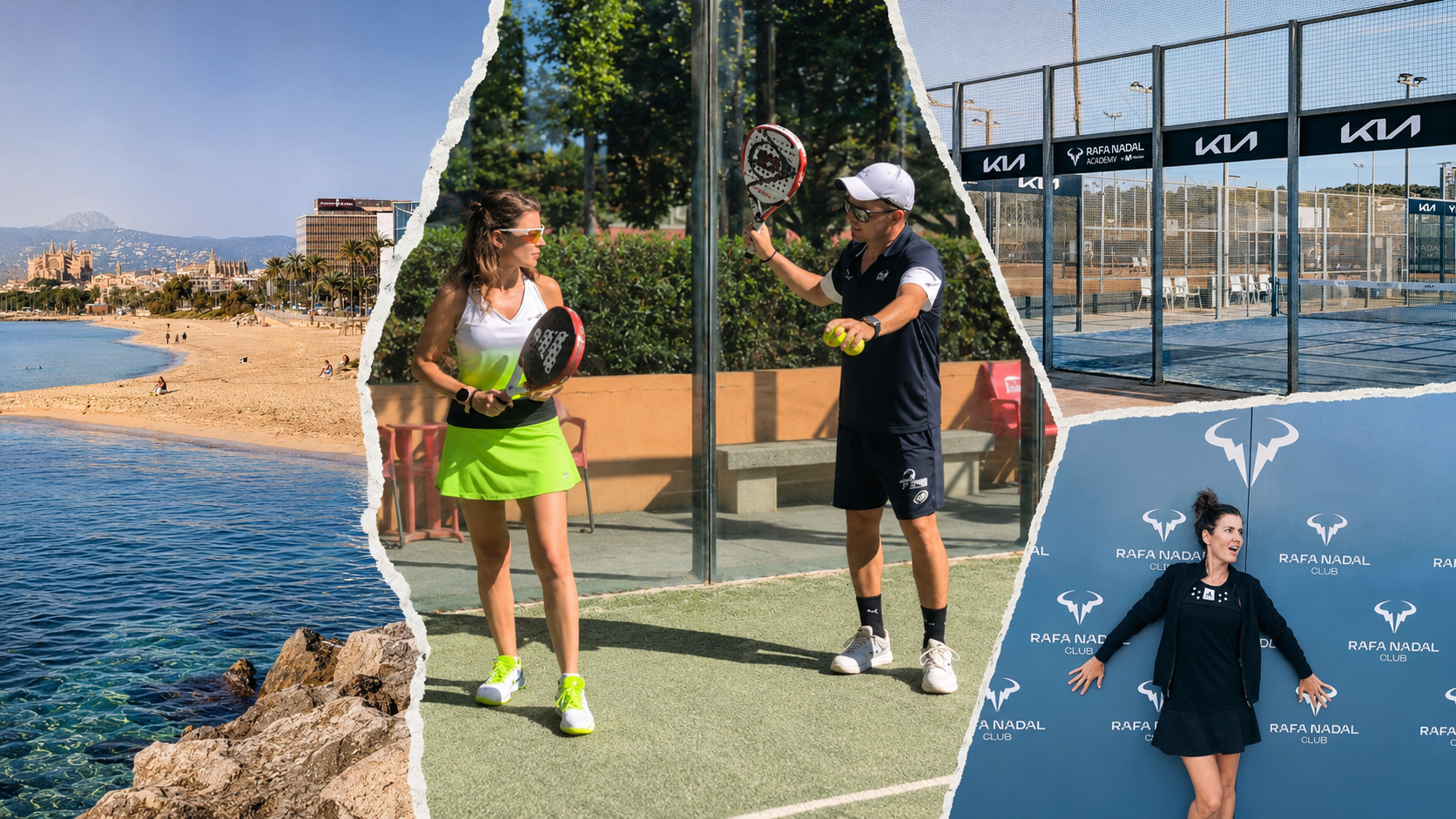
Mallorca is known for its beaches, its climate, its coves and its outdoor lifestyle. But if there is one person who has also placed the island on the global sporting map, it is Rafa Nadal.
Rafa was born in Manacor, and from there he built a career that made many people associate Mallorca not only with holidays, but also with effort, talent, discipline and high-performance sport.
I have visited the Rafa Nadal Academy in Manacor several times, and the same idea always impresses me: behind every athlete who goes far, there are many hours of training, method, correction and people who help them improve.
The academy museum is a very special visit for any sports lover. There, you can see trophies from Rafa Nadal’s career, memories from great athletes, interactive experiences and audiovisual spaces that bring you closer to his story. But beyond the objects or the display cases, what the place really transmits is a philosophy: talent matters, yes, but without training, it does not go very far.
And, with all the necessary distance, the same happens in padel.
I started playing padel in 2022. Until then, my sport had been basketball. I played it from a young age and even became a referee for the Balearic Federation. But a padel court was a completely different world.
I remember my first match perfectly. I had never picked up a racket, I did not really know the rules and I had no idea where to position myself. Every time the ball touched the glass, I looked like a dizzy duck trying to guess where it was going to come out.
But I had such a good time that I thought: “there is something here.” And there was.
Padel hooks you because you can enjoy it from the very first day. But it also has a trap: if you only play matches, you may improve a little, but you can also spend months repeating the same mistakes.
That happened to me.
You think you are learning because you are playing more. But then someone comes along who knows how to play a deep lob, a ball off the glass or a well-placed bandeja, and you realise that running a lot or hitting hard does not always mean playing better.
That is why I decided to sign up for group lessons. And that is when my real progress began.
A good coach does not only teach you how to hit the ball. They help you understand the game. They correct your grip, your body position, your point of impact, your footwork and your positioning on court. They explain when to move up to the net, when to defend, when to play cross-court, when to accelerate and when, quite simply, not to make life more complicated than it needs to be.
Because in padel, the player who hits the hardest does not always win. Very often, the player who makes better decisions wins.
One of the biggest changes for me was learning how to read the ball after it hit the glass. At first, it was almost a comedy scene: the ball would hit the wall and I would arrive late, badly positioned or looking in completely the wrong direction. With training, you begin to understand the rebounds, wait for the ball, move more calmly and stop panicking every time the glass comes into play.
I also learned something that seems simple, but is not: being well positioned.
In padel, half the point is won before you even hit the ball. If you are in the right place, the ball feels easier. If you are badly positioned, even the simplest ball becomes a problem.
Thanks to weekly training sessions, in less than a year I went from not knowing where to stand to becoming part of a women’s fourth-division team in Mallorca. It was not magic. It was repetition, correction, patience and many hours on court.
And there is still a lot to improve.
In fact, this year I have set myself the goal of trying to play in third division. And if I dare to set that goal, it is because, thanks to my training sessions with Óscar, I feel more confident on court. But beyond his background as a Spanish champion, what really matters is how he makes you understand the game.
A good coach sees things you do not see. They detect that gesture you repeat without realising it. That bad decision you make out of habit. That movement that arrives late. That ball you could play more easily. And they also give you confidence when you start doing things well that once seemed impossible.
That is why at Grip and Trip, we are clear that a padel trip to Mallorca should not be only about playing matches.
Matches are important, of course. They are the fun, social and competitive part. But training sessions with qualified coaches bring something different: real learning.
In our packages, we want every player to enjoy Mallorca, but also to go home feeling that they have improved. It may be a technical correction, a better reading of the glass, more confidence at the net, a more controlled bandeja or simply a better understanding of how to move with their partner.
Not everyone comes with the same level or the same goal. Some want to compete better. Others want to gain confidence. Others come to enjoy themselves, but also appreciate someone explaining why that ball that “looked easy” ended up in the net.
And that is where training makes the difference.
Because playing padel in Mallorca is already a beautiful plan. But training, improving, sharing the court with good coaches and then enjoying the island makes the trip much more complete.
Rafa Nadal needed coaches, method and many hours of work to reach the very top of tennis. We are obviously not trying to turn anyone into a Grand Slam champion during their holidays.
But we do believe that any player can return from Mallorca with more than just matches played.
They can return with better technique, more confidence, new tools on court and a different way of understanding padel.
And if they do all of that surrounded by sunshine, good company, local plans and the energy of Mallorca, then training stops being just a lesson and becomes part of the journey.
Padel in Mallorca: The Complete Guide to the Sport, the Island and Its Best Plans
Discover how to experience padel in Mallorca: trips, coached training, corporate tournaments, camps and the best plans in Palma with Grip and Trip.
How Grip and Trip Was Born: Padel Trips in Mallorca with a Local Soul
Discover how Grip and Trip was born, a padel travel agency in Mallorca created to bring together sport, tourism, local plans and personalised experiences on the island.
Places to Unwind After Playing Padel in Mallorca
Discover places to unwind after playing padel in Mallorca: Palma, the sea, terraces, culture, local neighbourhoods and perfect corners to slow down after the match.
My Favourite Combination in Mallorca: Padel, Cala Sa Bella Dona and Local Gastronomy
Discover a different way to experience Mallorca by combining padel in Calvià, a swim at Cala Sa Bella Dona and Mallorcan gastronomy by the Mediterranean.
Padel Trip to Mallorca for Couples, Small Groups and All Levels
Discover how at Grip and Trip we adapt padel trips in Mallorca to couples, small groups and players of all levels so they can enjoy, improve and experience the island.
Padel Trips and Padel Camps in Mallorca: Two Ways to Experience Grip and Trip
Discover the two ways to experience padel in Mallorca with Grip and Trip: personalised trips for small groups and future camps with fixed dates, training sessions and local experiences.